Why I Program Bench Press 2–3x Per Week

Bench press generally responds well to higher frequency.
This is a big reason that the majority of intermediate and advanced lifters I program bench 2–3 times per week.
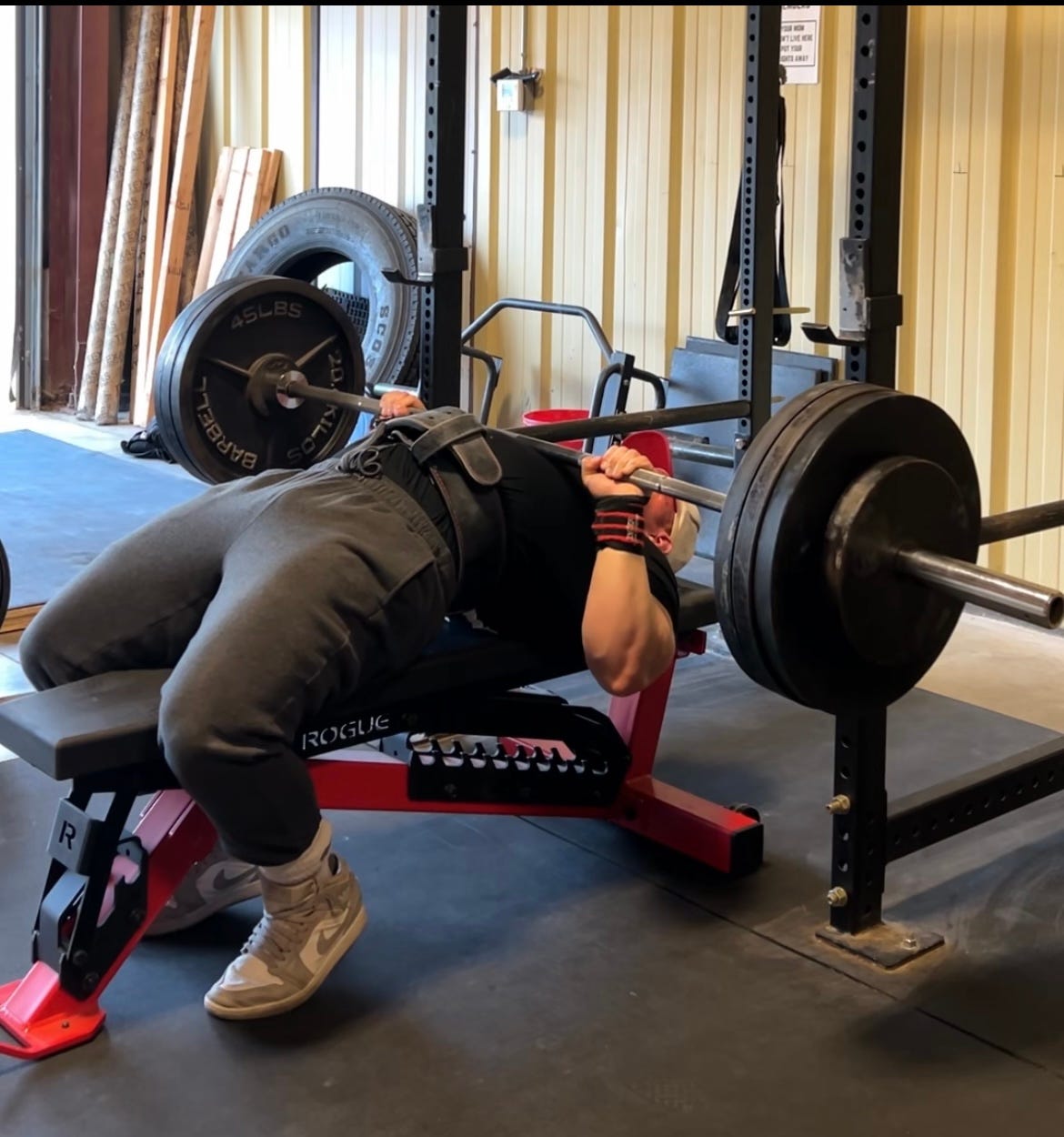
That’s not because more is necessarily always better, but rather simply because bench is different from squat and deadlift.
Heres why I favor higher frequency bench press training👇
1️⃣ Bench Is Highly Technical
Small setup changes cost big output in the bench press compared to squat and deadlift.
A slightly loose upper back.
A drifting touch point.
Minor elbow flare.
Inconsistent leg drive timing.
None of those feel dramatic in the moment, but under heavy load, they matter.
Bench has a smaller margin for error than squat or deadlift. The muscle mass involved is smaller, and the lift depends heavily on position and timing.
When you only bench once per week, you’re often re-learning the setup every session.
Higher frequency means more technical practice.
2️⃣ It’s Less Systemically Fatiguing
Bench doesn’t tax the entire system the way squat and deadlift do.
That matters.
Because it means we can:
Increase exposure
Accumulate quality volume
Reinforce technical consistency
All without crushing recovery.
Of course, higher frequency only works when fatigue is managed (its why I only recommend 2-3x a week, not 7)
But when structured correctly, it allows more skill practice without derailing the rest of the week.
3️⃣ It Rewards Coordination
For a simple movement on the surface, bench press requires a lot of neuromuscular coordination.
The bench press requires:
Stable scapular position
Controlled eccentric tension
Smooth transition off the chest
Intentional upper arm path
Timed leg drive
The more often you practice that sequence, the more automatic it becomes.
This sharpness leads to easier expression of maximal strength
That’s what people mean when they talk about neural efficiency.

In simple terms:
You become better at using the strength you already have.
Why This Matters More As You Get Stronger
At beginner levels, almost anything works.
At intermediate and advanced levels, progress slows because variability increases.
Heavy benches are often missed not because the lifter lacks strength..but because their technique needs to be further dialed in to where not an INCH is wasted.
Higher frequency reduces those small errors.
And small errors are what separate a smooth PR from an ugly miss.
The Key: Frequency Without Chaos
Benching more doesn’t mean maxing 7x a week
It means:
Structured exposure
Intentional variation (pause, close-grip, floor press, different tempos)
Managed fatigue
Clean reps only
Frequency builds skill➡️Skill reduces technical variability.➡️Reduced variability allows strength to show up at will.
Bottom Line
Bench responds well to higher frequency because:
It’s highly technical
It tolerates more exposure
It rewards repetition
It sharpens coordination
Practice the movement often enough, and strength progress feels remarkably predictable.
If your bench feels inconsistent week to week, it’s rarely an effort problem.
It’s usually a structure and technique problem.
Inside Gainz Dealer Club, we program for optimization of your true strength and teach you the WHY behind what works and what doesn’t!
If you want a structured plan and feedback on your own lifts, you can learn more here:
👉 Gainz Dealer Club